

Payroll is one of those business functions that can look simple until something goes wrong.
For a company with five employees, payroll might mean processing the same monthly salaries, sending payslips and making sure PAYE is reported correctly. Once a business starts hiring regularly, introducing bonuses, running several pension arrangements or employing people outside the UK, the job becomes much more demanding.
That is also why comparing payroll companies in London is not as straightforward as comparing ten businesses offering exactly the same service.
Some providers are traditional payroll bureaus. You send them the information and they process payroll on your behalf.
Others are technology-led services where your team works inside a payroll platform but specialists carry out or check important parts of the process.
At the other end of the market are enterprise providers capable of dealing with thousands of employees, several legal entities and payroll across multiple countries.
We reviewed the way these providers position their services, the types of employers they are designed for, the level of payroll administration they can take over, their technology and the pricing information available publicly.
The result is not a list where number one is automatically right for every business.
Instead, it is a practical guide to understanding which payroll company is likely to suit your particular situation.
Best Payroll Companies in London at a Glance
One thing becomes clear quite quickly when comparing these providers: size is not necessarily an advantage.
A ten-person London consultancy may receive a better-fit service from a focused payroll bureau than from a global provider built for multinational organisations.
Likewise, an employer operating in seven countries should probably care much more about international payroll infrastructure than whether its provider happens to have an office a few Underground stops away.
That distinction is worth keeping in mind throughout this comparison.
1. PayCheck – A Strong Option for London SMEs Wanting Payroll Fully Managed
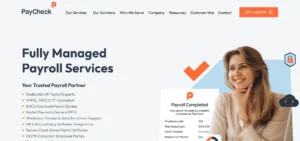
PayCheck is one of the more naturally relevant providers for businesses specifically searching for payroll services in London.
The company has longstanding roots in Battersea and focuses heavily on managed payroll rather than expecting employers to become payroll specialists themselves.
That distinction matters.
Some platforms provide excellent payroll technology but still require somebody inside the business to understand the process, enter information correctly, review each pay run and deal with exceptions.
A managed bureau is more attractive when the objective is to remove much of that administration from an internal finance or HR team.
PayCheck’s service covers areas such as payroll processing, PAYE administration, pensions and payment-related services. It also operates as a BACS-approved bureau.
Where Paycheck Appears Strongest
It looks particularly suitable for small and medium-sized businesses where payroll currently sits with someone who has several other responsibilities.
A finance manager, office manager or business owner may be able to run payroll internally, but that does not necessarily mean it is a good use of their time.
Outsourcing becomes increasingly attractive when one member of staff is spending several days each month collecting changes, checking deductions, preparing payment files and answering employee questions.
Where It May Be Less Suitable
A multinational employer looking for consolidated payroll reporting across numerous jurisdictions is likely to need a different type of infrastructure.
For straightforward UK payroll, however, a specialist managed service can often be more appropriate than a large global platform.
Best for: SMEs wanting a London-based managed payroll provider.
Pricing: Individual quotation.
2. Direct Payroll Services – A More Traditional Local Payroll Bureau

Direct Payroll Services is another provider that fits naturally into the local payroll-bureau category.
Its approach is relatively straightforward: businesses provide payroll information and the bureau handles much of the processing.
For many small employers, that simplicity is actually an advantage.
Not every company needs a large HR platform, workforce analytics, international employment tools or sophisticated integrations.
A business employing 20 people from one London office may simply want accurate payroll, dependable communication and someone available when a problem arises.
Why a Traditional Bureau Can Still Make Sense
Payroll software has improved considerably, but software does not eliminate administration.
Someone still has to:
collect employee changes,
check salary amendments,
manage starters and leavers,
review deductions,
check pension information,
deal with statutory payments,
and make sure the final payroll is correct.
A bureau can remove a meaningful proportion of that workload.
What to Ask Before Choosing a Smaller Bureau
The most important questions are less about the number of software features and more about day-to-day service.
Ask who your normal contact will be, how quickly urgent corrections are handled, what happens if information arrives after the payroll cut-off and whether additional payroll runs cost extra.
Those issues can matter more than a long list of platform functions.
Best for: Small and medium-sized businesses wanting personal payroll support.
Pricing: Quote required.
3. Payroll Services London – Useful for Establishing a Price Benchmark

Payroll pricing is surprisingly difficult to compare.
Many providers reveal little or no meaningful pricing information before a business speaks to sales.
Payroll Services London is notable because it publishes a starting price of £3.25 per payslip for its outsourced payroll service.
That does not automatically make it the cheapest service.
A per-payslip price should never be considered in isolation because the final cost may depend on pension administration, BACS payments, additional payroll runs, year-end work and other services.
However, a visible starting figure is useful.
Why Published Pricing Matters
Imagine asking four payroll companies for quotations.
Three provide bespoke monthly figures, while one gives you a clearly stated charging structure.
Even if you do not choose the transparent provider, you now have a useful benchmark for questioning the other proposals.
For example, if one company quotes substantially more, you can ask exactly what additional work is included.
That makes the buying process more informed.
The Main Limitation of Price-first Comparisons
The cheapest payroll service is not automatically the lowest-cost service for the business.
If a slightly cheaper provider requires a finance employee to spend four extra hours every month preparing spreadsheets and resolving queries, the apparent saving can disappear quickly.
Best for: Smaller employers wanting outsourced payroll with a visible starting price.
Published starting price: £3.25 per payslip at the time of review.
4. Moorepay – Better Suited to Businesses Growing Beyond Basic Payroll
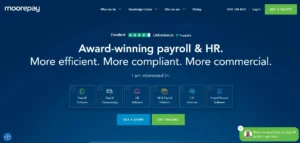
Moorepay becomes more interesting when payroll is part of a wider people-management problem.
A small business may initially need little more than monthly payroll processing.
As headcount increases, however, the organisation may also need better employee records, absence management, HR workflows, reporting and employee self-service.
At that point, using completely separate systems can create unnecessary administration.
Moorepay combines managed payroll with broader HR technology, making it more relevant to businesses that expect their internal processes to become more sophisticated.
Where the Service Stands Out
The managed payroll model means businesses can use technology without necessarily having to operate every part of payroll internally.
That gives employers a middle ground between a traditional bureau and a software-only product.
Who Should Look Elsewhere
A microbusiness with a very straightforward payroll may not need the breadth of functionality available.
If there are only six employees and little expectation of rapid growth, a smaller payroll bureau or simple payroll software could prove more economical.
The value becomes clearer as employee numbers and HR administration increase.
Best for: Growing SMEs wanting payroll and HR capability from the same provider.
Pricing: Quote required.
5. SD Worx – An Interesting Option for SMEs Planning Ahead

SD Worx covers a wide range of payroll requirements, from services for smaller employers through to larger organisations.
One useful difference is pricing visibility.
Selected small-business managed payroll packages have been advertised from £4 per employee per month.
That gives buyers at least an initial reference point before speaking to the provider.
Why Scalability Matters Earlier Than Businesses Think
Changing payroll companies is possible, but it is rarely something an employer wants to do frequently.
Employee records, year-to-date payroll figures, pensions, tax information and integrations may all need to move.
For that reason, businesses should think about where they expect to be in two or three years rather than choosing purely for today’s workforce.
A provider that works comfortably for 25 employees but becomes restrictive at 100 could create another migration project just as the company is growing rapidly.
SD Worx becomes more compelling when that future scalability matters.
What Buyers Should Confirm
A published starting price should still be treated as a starting point.
Businesses need to establish what is included in their own quotation and whether services such as implementation, pension administration, payments or additional payroll runs attract separate charges.
Best for: SMEs wanting managed payroll that can expand with the organisation.
6. IRIS – Useful When You Do Not Want to Outsource Everything at Once
A common mistake is thinking payroll has only two possible models:
do everything internally or outsource everything.
In practice, many businesses sit somewhere in the middle.
An employer may be comfortable controlling payments but want a specialist to prepare calculations and HMRC submissions.
Another business may want the provider to take responsibility for almost the whole monthly process.
IRIS is particularly relevant because its payroll offering covers different levels of service rather than forcing every customer into exactly the same approach.
Why This Flexibility Can Help
The right outsourcing model often changes as a business grows.
A finance team may initially want to retain substantial control. Later, after employee numbers rise, it may decide that the administration is no longer worthwhile.
Being able to change the division of work without changing provider can be useful.
IRIS also has a substantial presence across UK payroll software and outsourced payroll, which may appeal to companies wanting an established provider.
Best for: Businesses that want flexibility over how much payroll work remains in-house.
Pricing: Depends on the service selected.
7. PayFit – A Different Approach for Technology-Led Businesses

PayFit represents a newer style of payroll service.
It is neither a conventional bureau where the business sends everything away nor simply software that leaves the customer to operate payroll independently.
Instead, the platform gives employers visibility over payroll while specialists support the process.
This hybrid approach tends to appeal to businesses already comfortable managing operations through cloud software.
Why Startups May Prefer This Model
Fast-growing businesses often want two things that can appear contradictory:
they want experts involved, but they also want immediate access to their information.
A traditional outsourced service can sometimes feel like a black box. Information is sent away and completed reports return later.
With a technology-led platform, managers can typically see more of what is happening during the process.
That may also make integrations with accounting, HR and other business systems more useful.
Who May Prefer a Conventional Bureau
Not every employer wants another software platform.
A small company that simply wants to email its monthly changes to a payroll specialist may find a traditional managed service easier.
Best for: Startups, digital businesses and SMEs that value software visibility.
8. MHR – Better for Payroll Complexity Than for Small-Business Simplicity
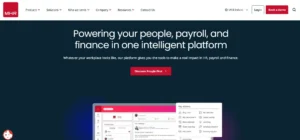
MHR operates towards the larger end of the payroll market.
That means it should not really be compared with a small London payroll bureau purely on headline pricing.
Large employers face a different set of payroll problems.
It is possible for two companies with the same number of employees to have dramatically different levels of payroll complexity.
Consider two 500-person employers.
The first pays everyone monthly, has one legal entity and rarely processes overtime.
The second operates several payrolls, has multiple entities, pays variable shifts and bonuses, has frequent employee turnover and manages complicated pension arrangements.
Their headcounts are identical, but the work required to run payroll is not.
Where Mhr Becomes Relevant
Enterprise payroll providers become more useful when an employer needs robust controls, sophisticated reporting and the ability to manage large volumes of payroll data reliably.
Smaller organisations should therefore avoid assuming that an enterprise provider is automatically “better”.
The more appropriate question is whether their payroll is complicated enough to justify that level of infrastructure.
Best for: Medium and large employers with complex payroll requirements.
Pricing: Bespoke.
9. TopSource – Worth Considering Before International Hiring Begins

A London company can become an international employer surprisingly quickly.
A software business might hire a salesperson in Germany, a developer in Poland and a manager in the United States within a relatively short period.
At that point, payroll stops being solely a UK administrative task.
TopSource is particularly relevant because it combines UK payroll with wider international payroll and employment services.
Why International Growth Changes the Decision
Managing one UK payroll provider is relatively straightforward.
Managing separate providers in several countries can become much more difficult.
Finance teams may have different reports, currencies, cut-off dates, payroll calendars and contacts in every jurisdiction.
A global provider can help consolidate some of that administration.
That capability is unnecessary for many local businesses, but it can become highly valuable for companies that already know overseas hiring is part of their growth strategy.
When Not to Pay for International Capability
If there is no realistic plan to employ people outside the UK, a specialist local provider may offer better value.
Buying capability that you are unlikely to use rarely makes sense.
Best for: London-based businesses planning international hiring.
Pricing: Quote required.
10. ADP – Most Relevant When Payroll Is a Global Operation

ADP is one of the best-known payroll providers internationally.
Its scale is an advantage for the right type of employer but can be irrelevant for others.
A multinational headquartered in London may need visibility over payroll across Europe, Asia and North America.
That organisation has very different requirements from an independent London retailer employing 14 people.
Where ADP Makes the Strongest Case
International consistency is one of the clearest reasons to consider a large provider.
If senior finance or HR teams need consolidated reporting across countries, using disconnected local payroll bureaus can make management difficult.
A global service can provide greater centralisation.
Why Bigger is Not Automatically Better
Small employers should not assume that choosing the most recognisable payroll brand will automatically produce the best experience.
Service model, support, cost and complexity remain more important.
Best for: Large and multinational businesses.
Pricing: Bespoke quotation.
What We Noticed When Comparing London Payroll Providers?
After comparing the different service models, several practical differences stood out.
Local Providers Tend to Compete More Heavily on Service
Smaller bureaus usually cannot compete with multinational companies on the size of their software platforms.
Instead, their advantage is often accessibility.
A business may know the individual who processes its payroll and be able to discuss a problem directly with the same person.
For a small employer, that can be extremely valuable.
Larger Providers Sell a Broader Operating System
As providers become larger, payroll increasingly forms part of a wider HR or workforce-management platform.
That becomes useful when companies have dedicated HR departments, multiple locations, complicated reporting or significant employee administration.
It can be unnecessary overhead for a small company.
International Payroll Is Its Own Category
Global payroll should not be treated simply as a larger version of UK payroll.
Multi-country employers need to deal with different tax systems, currencies, employment requirements and reporting processes.
Businesses expecting international expansion should therefore consider this requirement early.
Payroll Pricing Is Still Harder to Compare Than It Should Be
One of the clearest weaknesses in the market is pricing transparency.
Many managed providers ask businesses to request a quotation.
That is understandable because payroll complexity varies, but it makes comparison more difficult.
Businesses therefore need to create their own standard quote specification.
How to Compare Payroll Quotes Properly?
Do not send one provider a different set of requirements from another.
Create one example payroll and send exactly the same information to each shortlisted supplier.
For example:
Then ask every provider for the total expected annual cost.
This is much more useful than comparing one provider’s price per payslip with another provider’s monthly package.
Ask What Is Not Included
This is where payroll quotes can become expensive.
Check separately for:
implementation fees,
year-end work,
P11Ds,
additional pay runs,
late changes,
pension administration,
BACS processing,
custom reports,
minimum monthly charges,
and termination or migration fees.
A low monthly fee can become far less attractive once optional charges are added.
Calculate the Cost of Internal Payroll Time Too
Provider fees are only one part of payroll cost.
Consider an employee earning £35,000 who spends six hours every month preparing, checking and resolving payroll.
That internal time has a cost.
If outsourcing reduces the workload to one hour of checking, the business has recovered five hours every month even if the external invoice is higher than the cost of payroll software.
A useful way to think about it is:
Total payroll cost = provider/software cost + internal administration time + correction work + additional charges
This gives a more realistic picture than looking only at the monthly invoice.
What Should a Managed Payroll Provider Actually Do?
The exact service varies, but employers should expect clear responsibility for agreed payroll tasks.
These may include gross-to-net calculations, PAYE deductions, National Insurance, RTI submissions, payslips, statutory payments, starters and leavers, pension deductions, payroll reporting and year-end administration.
The important part is not assuming something is included.
It should be written into the service agreement.
For example, “pension support” could mean the provider calculates pension deductions.
It could also mean it assesses employees, sends pension files and deals with pension-provider administration.
Those are different levels of service.
What Should Employers Check for 2026/27?
London employers follow UK payroll legislation rather than a separate London payroll system.
For the 2026/27 tax year, employers need payroll processes that correctly handle current PAYE, National Insurance and workplace pension requirements.
The standard employer National Insurance rate remains 15% above the applicable threshold.
The National Living Wage for workers aged 21 and over is £12.71 per hour from April 2026.
Accurate RTI reporting also remains fundamental to PAYE administration.
This may sound obvious, but one reason businesses outsource payroll is that rates and statutory requirements can change while their internal team is focused on running the company.
Does Outsourcing Payroll Remove Your Responsibility?
No.
Employers should understand this before signing with any payroll bureau.
Using a payroll provider transfers much of the administration, but it does not completely transfer the employer’s legal responsibility for PAYE.
Someone inside the business should still review the payroll.
That review does not need to involve manually recalculating every employee’s pay.
Instead, look for unusual movements.
If gross payroll usually sits around £120,000 and suddenly rises to £155,000, ask why.
Check large bonuses, new starters, leavers, unusual deductions and pension movements.
Good payroll oversight is often about identifying what looks different rather than checking every normal transaction.
When Does Outsourcing Start to Make Sense?
There is no employee number where outsourcing suddenly becomes necessary.
Complexity matters more.
A business with 30 salaried employees may have a very easy payroll.
A restaurant with 15 workers may have variable hours, overtime, tips, frequent starters and different pay patterns.
The smaller employer could actually have the more time-consuming payroll.
Outsourcing becomes worth considering when:
payroll regularly consumes management time;
the person processing it is not a payroll specialist;
errors are becoming more frequent;
employee numbers are growing;
pay structures are becoming more complicated;
or compliance changes are difficult to follow.
When Is Payroll Software a Better Choice?
Outsourcing is not always necessary.
Small employers with predictable monthly payroll may be perfectly capable of using payroll software internally.
This can be cheaper and gives the company complete control over timing.
Software is more attractive when someone within the organisation understands payroll, payroll changes are limited and the business is comfortable handling HMRC processes itself.
The mistake is assuming software removes the work.
It automates calculations, but somebody must still manage the process.
Can You Switch Payroll Providers During the Tax Year?
Yes.
Businesses do not necessarily need to wait until April.
However, switching part-way through a tax year requires accurate year-to-date figures to move to the new provider.
This makes preparation especially important.
The incoming company may need information covering employee pay, tax, National Insurance, pension deductions, statutory payments and previous payroll submissions.
Ask whether the new provider carries out a parallel run before the first live payroll.
A parallel run means the new payroll is processed and compared with existing records before employees are paid through the new system.
For a complicated payroll, that additional check can be valuable.
Questions We Would Ask Every Payroll Company
Instead of asking a long list of generic questions, focus on situations that show how the service works in practice.
Who actually processes our payroll every month?
A named contact can be very different from a general support inbox.
What happens if we send a change after the cut-off?
Late changes happen in real businesses.
How do you correct an employee who has been paid incorrectly?
The answer tells you more about service quality than a sales presentation.
What would make our monthly invoice increase?
This helps identify hidden variable charges.
How is employee data protected?
Payroll information includes salaries, addresses, bank details and other sensitive personal information.
What happens if we want to leave?
Understand notice periods, data exports and migration support before signing.
Which Payroll Company Is Best for Different Types of London Businesses?
The shortlist becomes much easier when the business type is clear.
Small Local Company
Start by comparing PayCheck, Direct Payroll Services and Payroll Services London.
These are more naturally aligned with businesses that mainly want UK payroll administration handled externally.
Fast-growing SME
Compare Moorepay, SD Worx and IRIS.
Their wider payroll and HR capabilities may be useful as headcount and administration increase.
Technology Startup
PayFit is worth considering where founders want specialist payroll support but still prefer a modern software-led experience.
Larger Organisation
MHR is more relevant once payroll complexity and workforce scale become major considerations.
International Employer
TopSource and ADP become stronger candidates when payroll needs to operate across several countries.
Final Verdict
There is no useful way to name one payroll company as the best choice for every London employer.
The better approach is to identify what you are actually trying to solve.
If the goal is simply to stop processing payroll internally, a specialist London bureau may be enough.
If employee numbers are increasing and HR administration is becoming more complicated, a managed payroll and HR platform may be a better long-term decision.
If overseas hiring is already happening, international payroll capabilities should become part of the selection process immediately.
And if payroll is straightforward and somebody inside the business is comfortable managing it, outsourcing may not be necessary at all.
The most sensible shortlist usually contains three different types of provider rather than three providers selling almost identical services. Compare a local specialist, a scalable managed service and either a technology-led or international option depending on your plans.
Then compare the total annual cost, the amount of internal work each option removes, the quality of support and how comfortably the provider could handle the business two or three years from now.
That practical buyer-first approach is the standard we use when reviewing business services for Companies.London.
Frequently Asked Questions
How Much Do Payroll Companies in London Charge?
There is no single London payroll price.
Costs depend on employee numbers, payroll frequency, complexity and the amount of administration being outsourced.
Managed payroll is often charged per employee, per payslip or through a monthly package.
Always compare the total annual cost rather than just the headline rate.
Is a Local London Payroll Company Better?
Not automatically.
A local provider can offer accessible support and may be particularly appealing to small businesses.
For larger or international organisations, technology, scalability and global payroll capabilities can be considerably more important than location.
Can a Payroll Company Deal Directly With HMRC?
Managed providers can usually handle agreed PAYE administration and RTI submissions on behalf of employers.
The employer nevertheless retains legal responsibility for its PAYE obligations.
Can Payroll Companies Manage Pensions?
Many can manage pension deductions and auto-enrolment-related processes, although the exact level of service differs.
Ask specifically whether pension assessment, data files and pension-provider submissions are included.
Is Payroll Outsourcing Suitable for Five Employees?
It can be.
Employee count alone does not determine whether outsourcing is worthwhile.
A business may prefer paying a specialist because management time is more valuable elsewhere.
However, very small businesses with straightforward payroll should also compare the cost of using payroll software internally.
What Month is Best for Changing Payroll Providers?
The start of a new tax year can simplify migration because there is less year-to-date information to transfer.
However, businesses can switch during the year if data is migrated and reconciled correctly.
Should I Choose the Cheapest Payroll Provider?
Usually not without comparing what is included.
Payroll errors affect employees directly.
A provider that costs slightly more but offers better support, fewer additional charges and less internal administration may ultimately provide better value.