
London has always been a city where law, finance, and commerce intersect. As one of the world’s leading legal and financial centres, it hosts global law firms, multinational corporations, investment institutions, and fast-growing technology startups. However, the legal sector is facing increasing pressure to operate more efficiently while managing growing regulatory obligations and rising client expectations.
Traditional legal workflows built around email chains, spreadsheets, paper documents, and manual reviews are becoming increasingly difficult to scale. Corporate legal teams must manage larger contract portfolios, law firms are expected to deliver services faster, and regulated businesses face stricter anti-money laundering and compliance requirements than ever before.
As a result, legal technology has evolved from a niche software category into an essential business function. Today’s legal technology companies help organisations automate contracts, streamline due diligence, strengthen compliance programmes, improve legal research, manage legal spending, and accelerate complex transactions.
London has emerged as one of the world’s most active legal technology ecosystems. Supported by a mature legal services market, a thriving venture capital environment, and increasing demand for operational efficiency, the city has become a launchpad for innovative legal technology companies serving both domestic and international markets.
The companies featured below represent some of the most influential legal technology businesses operating in London today. Together, they demonstrate how legal technology is helping organisations reduce friction, manage risk, and improve productivity across every stage of the legal lifecycle.
Quick Comparison of London’s Leading Legal Technology Companies
What Are Legal Technology Companies?
Legal technology companies, often referred to as legal tech or lawtech companies, develop software platforms and digital solutions designed to improve the delivery of legal services. Rather than replacing legal professionals, these technologies automate repetitive tasks, reduce administrative burdens, and provide better access to information.
The legal technology market spans several key categories:
Contract Lifecycle Management (CLM)
These platforms help organisations create, negotiate, approve, sign, and manage contracts throughout their lifecycle. Modern CLM systems transform contracts from static documents into searchable business data.
Legal Artificial Intelligence
Legal AI solutions use advanced machine learning and natural language processing to analyse contracts, conduct due diligence, identify risks, and support legal research.
Compliance and AML
Compliance platforms automate identity verification, source-of-funds checks, sanctions screening, and regulatory reporting, helping firms manage financial crime risks more effectively.
Legal Research
Research platforms provide access to legislation, case law, and legal commentary while using AI to identify relevant precedents and connections between cases.
Legal Operations
Legal operations software helps organisations manage legal spending, monitor external counsel performance, and improve departmental efficiency.
Property and Conveyancing Technology
These solutions focus on streamlining property transactions through automated due diligence, onboarding, identity verification, and transaction management.
Startup Legal Services
Designed for founders and investors, these platforms automate company formation, fundraising documentation, cap table management, and governance processes.
Why London Has Become a Legal Technology Hub?
London’s rise as a legal technology centre is driven by a unique combination of market conditions.
The city is home to some of the world’s largest law firms, a highly sophisticated financial services sector, and a thriving technology startup ecosystem. This creates strong demand for solutions that improve efficiency, reduce costs, and support compliance.
Regulatory complexity has also played an important role. Businesses operating in London must navigate anti-money laundering requirements, corporate governance obligations, data protection rules, and increasingly complex international regulations. Technology provides a scalable way to manage these challenges.
At the same time, advances in artificial intelligence have accelerated innovation across the sector. Legal technology companies are increasingly embedding AI into workflows ranging from contract analysis and legal research to compliance monitoring and transaction management.
This combination of commercial demand, regulatory pressure, and technological innovation has positioned London as one of the leading centres for legal technology development globally.
How Legal Technology Is Used in Practice
Consider a typical high-growth London business preparing for a funding round.
The company may use SeedLegals to automate investment documentation and manage shareholder records. Its legal team could rely on Juro to negotiate commercial agreements and monitor contractual obligations. Compliance checks might be handled through Thirdfort, while external legal spending is tracked through Apperio.
What once required multiple disconnected systems and significant administrative effort can now be managed through specialised legal technology platforms designed to streamline operations and reduce risk.
Top 10 Legal Technology Companies in London
1. Scissero

Website: https://www.scissero.com
The legal technology market has increasingly shifted beyond standalone software tools towards integrated legal operations platforms capable of combining technology, legal expertise, and workflow automation. This evolution has been particularly evident within asset management, private equity, and institutional finance, where organisations process substantial volumes of transactional documentation under tight commercial deadlines.
Scissero has positioned itself within this segment by combining artificial intelligence-driven document automation with regulated legal service delivery. The company focuses on streamlining the review, drafting, and negotiation of complex corporate agreements, helping financial institutions reduce manual workloads while maintaining legal oversight.
The company’s profile grew significantly following the integration of Robin AI’s managed services business and client portfolio. This development expanded Scissero’s operational capabilities and reinforced its position within London’s legal AI landscape.
What distinguishes Scissero is its hybrid operating model. Rather than functioning solely as a software provider, it combines technology-enabled legal workflows with professional legal expertise, allowing clients to scale legal operations without compromising quality or compliance standards.
As London continues to serve as a global centre for investment management, private equity, and corporate finance, platforms capable of reducing transactional friction are becoming increasingly important across the financial services sector.
2. Juro

Website: https://www.juro.com
Contract management remains one of the most significant operational bottlenecks within modern organisations.Many firms still rely on disjointed workflows using emails, Word documents, spreadsheets, and disjointed approval processes in spite of the pervasive digital revolution.
Juro was created to address this challenge through a browser-native Contract Lifecycle Management platform. The company enables organisations to create, negotiate, approve, sign, and manage contracts within a unified environment, transforming contracts from static documents into structured operational data.
A key area of focus for the company has been contract intelligence. Through its Operator capability, users can query contract repositories using natural language, enabling faster access to obligations, renewal dates, liabilities, and commercial commitments.
Juro’s approach reflects a broader industry shift towards data-centric legal operations. By treating contracts as searchable business assets rather than isolated files, the platform supports deeper integrations with enterprise systems and improves visibility across commercial workflows.
Within London’s technology and startup ecosystem, where rapid growth often creates significant contract complexity, platforms such as Juro play an important role in enabling scalable commercial operations.
3. Thirdfort

Website: https://www.thirdfort.com
Regulatory scrutiny surrounding anti-money laundering, identity verification, and financial crime prevention has intensified significantly across the legal and property sectors. For regulated businesses, compliance failures can result in substantial financial penalties and reputational damage.
Thirdfort operates at the intersection of legal technology, compliance, and financial crime prevention. Its platform combines biometric identity verification, source-of-funds analysis, Open Banking integrations, and sanctions screening within a single digital framework.
The company’s capabilities expanded following the integration of Homeppl’s document forensic technologies, enhancing its ability to detect anomalies, manipulation, and potential fraud within submitted financial documentation.
Unlike many compliance providers that focus on individual components of the verification process, Thirdfort consolidates multiple requirements into a unified workflow. This reduces administrative complexity while improving onboarding speed and regulatory readiness.
Given London’s position as one of the world’s most active real estate and financial centres, solutions that strengthen compliance controls while improving operational efficiency have become increasingly valuable across the market.
4. SeedLegals

Website: https://www.seedlegals.com
Early-stage businesses frequently encounter significant legal complexity during fundraising, governance management, and equity administration. Traditional legal support can be expensive and often creates delays during critical growth phases.
SeedLegals has become one of the UK’s most recognised startup legal technology platforms by automating many of these processes. The company provides tools for fundraising documentation, cap table management, employee share schemes, shareholder agreements, and corporate governance.
Its acquisition of The Pitch strengthened its position within the startup ecosystem by linking founder visibility and investor discovery with legal execution and fundraising infrastructure.
Rather than relying on bespoke legal drafting for routine transactions, SeedLegals standardises common startup legal workflows through automation. This approach helps founders complete fundraising activities more efficiently while maintaining legal compliance.
As London’s startup ecosystem continues to attract significant venture capital investment, platforms that simplify fundraising and governance processes remain essential components of the city’s innovation infrastructure.
5. Luminance
Website: https://www.luminance.com
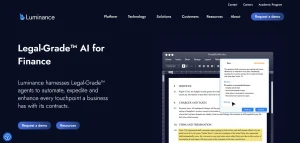
Corporate transactions, litigation matters, and regulatory investigations generate vast quantities of documentation that must be reviewed accurately and efficiently. Traditional review processes often require significant human resources and can create delays during time-sensitive projects.
Luminance has emerged as one of London’s most prominent legal AI companies by addressing this challenge through machine learning-powered document intelligence. The platform analyses large volumes of unstructured legal data, automatically identifying anomalies, highlighting unusual contractual provisions, and surfacing potential risks.
Its technology is widely used across enterprise legal departments, international law firms, and advisory organisations involved in mergers and acquisitions, due diligence exercises, and regulatory reviews.
What differentiates Luminance is its focus on machine learning-driven pattern recognition rather than conventional keyword-based analysis. This enables legal professionals to identify relationships and inconsistencies across document collections that may otherwise remain undetected.
For London’s legal market, where international transactions and complex corporate structures are commonplace, document intelligence platforms have become increasingly important operational tools.
6. Definely

Website: https://www.definely.com
Drafting and reviewing legal agreements often requires professionals to navigate lengthy documents containing extensive definitions, references, schedules, and cross-linked provisions. This process can be time-consuming and prone to error.
Definely was developed to improve productivity within the drafting process itself. The platform integrates directly into Microsoft Word, allowing legal professionals to access definitions, references, and contextual information without interrupting their workflow.
Unlike broader legal operations platforms, Definely focuses specifically on the drafting experience. Its tools are designed to reduce administrative friction, improve accuracy, and help lawyers work more efficiently within familiar environments.
This targeted approach has contributed to strong adoption among commercial lawyers, transactional teams, and in-house legal departments seeking practical productivity improvements.
In a market such as London, where legal professionals regularly manage complex commercial agreements under tight deadlines, workflow optimisation tools can deliver significant operational value.
7. vLex
Website: https://www.vlex.com
The volume of legal information available to modern legal professionals continues to expand rapidly. Case law, legislation, regulatory guidance, and academic commentary are increasingly distributed across multiple jurisdictions and information sources.
vLex addresses this challenge through an extensive legal research platform supported by artificial intelligence capabilities. The company provides access to legal materials from numerous jurisdictions while helping users identify relevant authorities, precedents, and citation relationships.
Its AI-powered research assistant enhances traditional legal research by enabling users to analyse legal questions through a more contextual and interconnected framework.
What makes vLex particularly valuable is its ability to connect legal information across borders. This capability supports legal professionals working on international disputes, cross-border transactions, and comparative legal analysis.
Given London’s role as a global centre for arbitration, litigation, and international legal services, sophisticated research platforms remain critical infrastructure for many legal organisations.
8. Legatics
Website: https://www.legatics.com
Large corporate transactions involve extensive coordination between multiple stakeholders, legal teams, financial institutions, and advisors. Managing these activities through spreadsheets and email communications often introduces inefficiencies and execution risks.
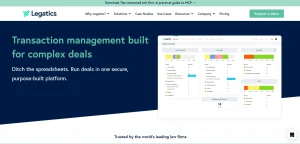
Legatics was developed specifically to modernise transaction management within legal and financial workflows. The platform converts traditional closing checklists into structured digital environments where deal participants can track progress, manage obligations, and coordinate documentation more effectively.
Its technology is widely used across banking, finance, private equity, and M&A transactions where transparency and execution certainty are critical.
Unlike generic project management platforms, Legatics focuses on the specific requirements of legal transactions, making it particularly relevant for professionals managing complex deal structures.
As London remains a major centre for corporate finance and cross-border transactions, transaction management technology continues to play an increasingly important role in improving operational efficiency.
9. Apperio

Website: https://www.apperio.com
Corporate legal departments face increasing pressure to demonstrate financial accountability while managing growing workloads and external legal expenditure. However, many organisations lack real-time visibility into legal costs until invoices are received.
Apperio addresses this challenge through legal spend analytics and legal operations technology. The platform integrates directly with law firm billing systems, enabling organisations to monitor legal expenditure, analyse trends, and improve budgeting processes.
Its approach shifts legal cost management from retrospective invoice review towards proactive financial oversight, allowing organisations to identify risks before budgets are exceeded.
This visibility has become increasingly important for general counsel, finance leaders, and legal operations professionals seeking greater control over legal spending.
Within London’s competitive corporate environment, where cost management and operational efficiency remain strategic priorities, legal spend transparency has become a critical capability.
10. Farewill

Website: https://www.farewill.com
While much of the legal technology market focuses on enterprise and corporate clients, significant innovation is also occurring within consumer legal services.
Farewill has emerged as one of the UK’s leading digital estate planning providers by simplifying will writing, probate administration, and related legal processes through technology-driven workflows.
The platform replaces traditionally complex paper-based procedures with accessible digital experiences designed to improve transparency and usability for consumers.
Its success reflects a broader trend towards the democratisation of legal services, where technology helps expand access while reducing administrative complexity.
Although operating within a different segment of the legal market than many enterprise-focused providers, Farewill demonstrates how legal technology can improve efficiency and accessibility across a wide range of legal services.
As demand for digital-first legal experiences continues to grow, consumer-focused platforms are likely to play an increasingly important role within London’s wider legal technology ecosystem.
Comparison Table of Leading Legal Technology Companies in London
The legal technology market covers a wide range of operational challenges, from contract management and compliance to legal research and transaction execution. The table below provides a quick comparison of London’s leading legal technology companies and the areas where they deliver the greatest value.
Key Trends Shaping London’s Legal Technology Market
The legal technology sector is evolving rapidly. What started out as a collection of specialized software tools has grown into an advanced ecosystem that covers all phases of the legal lifecycle.
The future course of the legal technology market in London is now being shaped by a number of developments.
The Rise of AI-Powered Legal Operations
Artificial intelligence has moved beyond simple document review and automated drafting.
Modern legal technology platforms increasingly use AI to support contract analysis, compliance monitoring, due diligence, legal research, and workflow management. Rather than functioning as standalone tools, these systems are becoming embedded within broader legal operations frameworks.
The focus is shifting from task automation towards intelligent operational support, enabling legal teams to make faster and more informed decisions.
Compliance and Financial Crime Prevention
Regulatory pressure continues to drive technology adoption across the legal sector.
Property lawyers, conveyancers, law firms, and regulated businesses face increasing obligations related to anti-money laundering, identity verification, sanctions screening, and client due diligence.
As a result, compliance technology is becoming a core component of legal operations rather than a standalone administrative function.
Legal Teams Are Being Asked to Do More with Less
In-house legal departments are under pressure to manage increasing workloads without proportionally increasing headcount.
This challenge has accelerated demand for contract automation, workflow optimisation, legal spend analytics, and self-service legal tools that allow business teams to complete routine processes independently.
Technology is helping legal departments operate as strategic business functions rather than purely reactive support teams.
Greater Demand for Data Transparency
Legal functions are increasingly expected to demonstrate measurable business value.
General counsel, finance teams, and executive leadership want greater visibility into contract performance, legal spending, risk exposure, and operational efficiency.
This demand has fuelled the growth of legal operations platforms capable of providing real-time reporting and analytics.
Consolidation Across the Legal Technology Market
The legal technology sector is also experiencing increasing consolidation.
As enterprise buyers seek integrated solutions rather than fragmented software stacks, providers are expanding their capabilities through acquisitions, partnerships, and platform development.
This trend is likely to continue as organisations prioritise simplicity, interoperability, and unified user experiences.
How to Choose the Right Legal Technology Company
Selecting a legal technology provider requires a clear understanding of the operational challenges an organisation is attempting to solve.
The most successful implementations are typically driven by business objectives rather than technology alone.
For Law Firms
Law firms should focus on solutions that improve productivity, reduce administrative workloads, and strengthen client service delivery.
Key considerations include:
- Integration with existing document management systems
- Workflow compatibility with Microsoft Word and established legal tools
- Security certifications and compliance credentials
- Scalability across practice groups
Platforms such as Definely, Luminance, Legatics, and vLex may be particularly relevant depending on the firm’s operational priorities.
For In-House Legal Teams
Corporate legal departments often require solutions that support contract management, compliance oversight, and cost control.
Important evaluation criteria include:
- Contract lifecycle management capabilities
- AI-powered contract intelligence
- Legal spend visibility
- Integration with CRM and ERP systems
Platforms such as Juro and Apperio can help organisations improve operational efficiency while maintaining governance standards.
For Startups and Growth Companies
Early-stage businesses need legal infrastructure that is cost-effective, scalable, and easy to implement.
Areas of focus should include:
- Fundraising automation
- Equity management
- Governance tools
- Self-service legal workflows
SeedLegals has become a popular option for organisations seeking to streamline these processes without relying heavily on traditional legal support.
For Property Professionals and Regulated Firms
Compliance and risk management remain critical priorities for organisations operating in highly regulated sectors.
Decision-makers should evaluate:
- Identity verification capabilities
- AML screening functionality
- Source-of-funds verification
- Fraud prevention tools
Thirdfort is one example of a platform specifically designed to address these requirements.
Conclusion
Legal technology companies have become an essential part of London’s business infrastructure. As organisations face increasing regulatory obligations, growing contract volumes, and pressure to improve operational efficiency, technology is playing a central role in transforming how legal services are delivered.
The companies featured in this list represent a diverse cross-section of London’s legal technology ecosystem. From contract lifecycle management and AI-powered document review to compliance, legal operations, transaction management, and estate planning, each addresses a distinct operational challenge facing modern organisations.
While no single platform can solve every legal challenge, selecting the right technology partner can significantly improve efficiency, reduce risk, and support long-term business growth.
As legal departments continue to evolve from administrative support functions into strategic business partners, legal technology is likely to become an even more important competitive differentiator across London’s legal and commercial landscape.
FAQs
What are legal technology companies?
Legal technology companies develop software platforms and digital solutions designed to improve the delivery of legal services. Their products typically focus on areas such as contract management, compliance, legal research, legal operations, and workflow automation.
Why is London considered a major legal technology hub?
London combines a globally significant legal services sector, a large financial services industry, a strong startup ecosystem, and complex regulatory requirements. These factors create significant demand for innovative legal technology solutions.
How is artificial intelligence being used in legal technology?
Artificial intelligence is commonly used for contract analysis, document review, legal research, due diligence, compliance monitoring, and workflow automation. Modern legal AI systems are increasingly integrated into broader legal operations platforms.
Can legal technology replace lawyers?
Legal technology is designed to support legal professionals rather than replace them. By automating repetitive tasks and improving access to information, technology allows lawyers to focus on higher-value advisory and strategic work.
Which legal technology category is growing the fastest?
Contract lifecycle management, compliance technology, legal AI, and legal operations platforms are among the fastest-growing segments within the legal technology market.
What should businesses look for when choosing a legal technology provider?
Key considerations include security, scalability, integration capabilities, ease of adoption, regulatory compliance, and the provider’s ability to solve specific operational challenges.
Are legal technology platforms suitable for small businesses?
Yes. Many legal technology providers offer solutions specifically designed for startups, small businesses, and growing organisations that need legal support without extensive internal resources.