

Research updated: 14 October 2026
An employee’s Microsoft 365 account is compromised late on Friday evening. Someone starts downloading confidential customer files. Your security software generates an alert, but nobody in the office sees it until Monday.
Would the cyber security company you hired have stopped the activity?
That is the kind of question businesses should ask before signing a security contract. A supplier may have respected accreditations, experienced consultants and an impressive customer list, yet its basic monitoring agreement might not include the authority to disable a compromised account.
Finding the right cyber security company in London involves understanding precisely what a provider does, how its capabilities have been independently assessed and what happens when a serious incident occurs.
For this investigation, Companies.london examined ten established providers serving London organisations. We reviewed official service descriptions, checked available NCSC assurance records, investigated published London office locations and compared several documented operational commitments.
We also analysed figures from the UK Government’s 2025/26 Cyber Security Breaches Survey and identified changes in the market that older business directories may have overlooked.
Our findings show why companies that look similar in a directory may be fundamentally different when it comes to incident response, penetration testing and ongoing security management.
What Did Our Investigation Find?
We found eight London contact locations across the ten selected providers. Six addresses were published on company websites, while two appeared in current NCSC CHECK records.
Five of the providers had verified CHECK penetration testing listings. Four had verified NCSC Cyber Incident Response assurance.
These figures describe our selected sample, not the entire London market.
More importantly, the research highlighted differences in how security services are delivered. Some suppliers specialise in investigating weaknesses before an attack. Others provide continuous monitoring, while several offer incident response and technical consultancy through separate engagements.
Our Original Research: 10 Cyber Security Companies Compared
Research note: CHECK status was examined through the NCSC’s public provider records. “Not confirmed” refers to this specific scheme; it should not be interpreted as evidence that a provider lacks other accreditations. An office address does not establish the location of the security team delivering a particular service.
The companies are presented by service relevance rather than independently measured performance. We did not assign invented ratings or suggest that a larger provider is automatically better.
1. NCC Group – For Complex Penetration Testing and Incident Response
Official website: https://www.nccgroup.com/
NCC Group is an established British cyber security provider with capabilities covering penetration testing, security consultancy, incident response and resilience assessments.
Among the providers examined, it has one of the broader sets of independently documented NCSC assurance services.
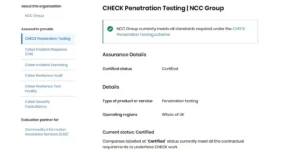
The NCSC identifies NCC Group under CHECK Penetration Testing, Cyber Incident Response, Cyber Incident Exercising, Cyber Resilience Audit, Cyber Resilience Test Facility and Cyber Security Consultancy.
These are separate activities. Being approved for one does not automatically mean that a customer purchasing another service receives every associated capability.
When Would NCC Group Be Worth Considering?
Suppose a London financial technology company is replacing its core customer authentication system.
The business may need an external penetration test before launch, followed by an incident response exercise to determine whether its internal teams can deal with a compromised customer account or exposed information.
NCC Group’s documented technical capabilities make it a relevant candidate for these requirements.
However, buyers should specify the assessment scope precisely. An application penetration test may not include the underlying cloud environment, associated third-party services or every API exposed by the application.
A useful proposal should identify those exclusions rather than leave the customer assuming everything has been tested.
Our buying assessment: NCC Group is a relevant shortlist candidate for complex technical assurance and regulated environments. Organisations with simpler requirements should determine whether they need its broader range of services.
Question to ask: Will the proposed engagement include remediation retesting, and is this covered by the original fee?
2. Bridewell – For Businesses Needing Consultancy and Managed Security
London office: 5 Merchant Square, London W2 1AY
Official website: https://www.bridewell.com/
Bridewell operates a London office in Paddington and provides cyber security consultancy, managed security, penetration testing and incident response.
Its published portfolio covers cloud infrastructure, traditional IT environments and operational technology, including security requirements associated with industrial systems.
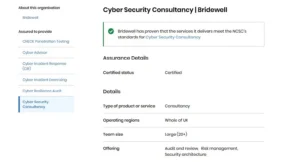
Bridewell also has independent NCSC assurance across several services, including CHECK, Cyber Advisor, Cyber Incident Response, Cyber Incident Exercising and Cyber Security Consultancy.
This makes it relevant to organisations seeking a broader security relationship rather than a single technical assessment.
What Should Buyers Examine?
Consider a medium-sized professional services business with a small internal IT department.
The IT team may already manage laptops, cloud accounts and network equipment. What it lacks is a specialist team to investigate suspicious activity, review security architecture and help develop incident response procedures.
Bridewell offers services that can address these different needs.
The important purchasing question is whether the provider will act as a technical adviser, operate monitoring systems or take direct responsibility for agreed incident response activities.
Those responsibilities should not be blurred.
Our buying assessment: Bridewell is worth considering when an organisation needs both security consultancy and ongoing operational support.
Question to ask: If an attacker compromises an employee account outside office hours, who can disable access immediately?
3. LRQA – Specialist Security Testing Under the Former Nettitude Brand
Official website: https://www.lrqa.com/
One of the clearest corrections required in older London cyber security directories concerns Nettitude.
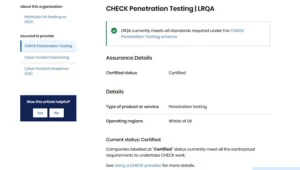
The NCSC identifies the organisation as Nettitude Ltd trading as LRQA.
This matters when comparing suppliers because a business should know which legal entity will provide the service and which name appears on the contract.
LRQA’s documented cyber security capabilities include penetration testing, cyber incident response and incident exercising.
Why Might a Business Choose LRQA?
A mature financial services organisation may already have security monitoring, internal cyber specialists and established technical controls.
Its immediate requirement may be independent verification rather than another monitoring platform.
It could need testing against known vulnerabilities, a realistic incident management exercise or a specialist review of a sensitive application.
LRQA’s capabilities make it relevant to these engagements.
Before choosing a provider, the customer should distinguish between a conventional penetration test and a wider red-team exercise.
A penetration test generally focuses on identifying weaknesses within an agreed scope. A red-team engagement may examine how effectively an organisation detects and responds to a simulated attacker pursuing defined objectives.
These should not be sold or purchased as interchangeable products.
Our buying assessment: LRQA is relevant for organisations with specific technical assurance and incident preparedness requirements.
Question to ask: Which systems will remain outside the assessment, and what evidence will be delivered to demonstrate that identified weaknesses have been corrected?
4. ITC Secure – For Managed Security in Microsoft-Heavy Environments

UK headquarters: 30 Churchill Place, London E14 5RE
Official website: https://itcsecure.com/
ITC Secure has a published headquarters address in Canary Wharf. Its service portfolio combines security consultancy and managed security operations.
Its managed detection and response offering includes continuous threat monitoring, investigation and response, supported by security technology and human analysis.
The company has a strong published focus on Microsoft-related security capabilities.
Where Does ITC Secure Fit?
Many London businesses depend on Microsoft 365 for email, documents, meetings and identity management.
They may already have security licences but lack the specialist staff needed to investigate alerts, review configuration weaknesses and respond quickly.
ITC Secure is relevant when considering an external team to manage this operational workload.
However, buying MDR does not automatically establish that every Microsoft service, cloud application or employee identity is covered.
The scope of monitored data is critical.
For instance, an endpoint-only service may generate useful device alerts without providing sufficient information about suspicious activity inside certain cloud applications.
Our buying assessment: ITC Secure is a candidate for businesses seeking managed security around Microsoft-centred technology environments.
Question to ask: Does the quoted service cover endpoint devices, Microsoft 365 identities, Azure resources and third-party applications, or only selected components?
5. Integrity360 – For Continuous Managed Detection and Response
London office: 11 Ironmonger Lane, London EC2V 8EY
Official website: https://www.integrity360.com/
Integrity360 operates a published office in the City of London.
The company provides managed security, technical consultancy, threat detection and response services.
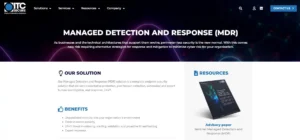
Its CyberFire MDR offering combines continuous monitoring with analyst-led investigation, threat detection and response support.
For businesses with several security technologies, this is potentially more useful than simply buying another application.
The Operational Difference Worth Investigating
A business might have endpoint security, email filtering, identity monitoring and network protection supplied by different vendors.
Each system produces information, but that information does not automatically become a coordinated incident investigation.
An MDR service can provide a team responsible for analysing relevant signals and escalating genuine threats.
Integrity360’s offering is relevant to that requirement.
Nevertheless, buyers should establish what happens after an alert is validated.
Does the supplier simply notify the customer? Can it isolate a device? Will it assist with recovery?
The answer should appear in the service agreement.
Our buying assessment: Integrity360 is a worthwhile candidate for organisations seeking dedicated monitoring and response without operating a fully staffed security operations centre internally.
Question to ask: What is the difference between the detection time, notification time and containment time promised in the agreement?
6. Cybanetix – London-Based Managed Security Operations

London office: Level 9, The Coade, 98 Vauxhall Walk, London SE11 5EL
Official website: https://cybanetix.com/
Cybanetix is one of the providers in our sample with a published London address and a service portfolio focused on security operations and managed security technology.
The company describes services involving security monitoring, threat detection, endpoint protection and the management of security platforms.
It is particularly relevant to businesses that already own security tools but need specialist assistance configuring and operating them.
Why Does the Operating Model Matter?
A business may have invested in security software over several years without establishing who is responsible for responding to its alerts.
One system could be managed by the IT department, another by an external contractor and a third by a software supplier.
This fragmentation can create delays when an incident involves more than one system.
Cybanetix’s service proposition is relevant to organisations seeking operational support across existing security technology.
The buyer should examine how the supplier integrates systems and handles the transfer of information between tools.
Our buying assessment: Cybanetix is worth investigating for managed security operations and security technology management.
Question to ask: If we change providers after two years, who owns the security configurations, detection rules, licences and historical monitoring data?
7. Kroll – Cyber Investigation, Digital Forensics and Managed Response
London office: The News Building, Level 6, 3 London Bridge Street, London SE1 9SG
Official website: https://www.kroll.com/
Kroll’s London office is independently identifiable through its official location page.
The company provides managed detection and response, incident investigation, digital forensics and wider risk advisory services.
Its Kroll Responder offering is supported by capabilities associated with Redscan, which became part of Kroll following its acquisition in 2021.
That ownership history is relevant because some older directories still present Redscan as though it were an unrelated competitor.
Where Kroll’s Proposition Differs
A security incident rarely ends when an infected device is disconnected.
Investigators may need to establish how an attacker gained access, whether data was accessed or removed, and whether malicious access remains elsewhere.
Kroll’s published MDR proposition places considerable emphasis on investigation, containment and remediation.
Its service information also describes a response model backed by forensic specialists.
However, buyers should verify exactly what work is included in their particular agreement.
A provider’s broad capability to perform complex digital forensics is not the same as a contractual commitment to provide every forensic activity without additional charges.
Our buying assessment: Kroll is relevant to businesses for which incident investigation and recovery support are major procurement considerations.
Question to ask: Does the agreement include forensic investigation beyond the initially affected endpoint, and what triggers additional fees?
8. Claranet – A Provider Publishing Measurable MDR Service Commitments
London contact in NCSC CHECK record: 17 Slingsby Place, London WC2E 9AB
Official website: https://www.claranet.com/
Claranet offers penetration testing, managed detection and response, and other managed technology services.
Its status as an NCSC-certified CHECK provider is documented in the current NCSC directory.
But another aspect of Claranet’s public information makes this company especially interesting to examine: its managed detection and response page sets out concrete operational commitments.
Rather than making only general promises about fast detection, the provider publishes specific service figures.
Original Research: Claranet’s Published MDR Metrics
These figures are supplied by Claranet itself. Companies.london has not independently tested its response performance, and specific contract terms may vary.
Nevertheless, the information provides a useful basis for direct comparison.
What Does a 15-Minute Notification Commitment Actually Mean?
The published figure begins when an incident has been classified as priority one.
It does not necessarily mean a customer will receive a telephone call within 15 minutes of an attacker’s first action.
Time may pass between suspicious activity occurring, the monitoring system detecting it, an alert being investigated and the incident being classified.
These stages matter when a business is comparing providers.
The buyer should ask each supplier to define when its service-level clock begins and what happens when a commitment is missed.
Our buying assessment: Claranet is relevant for technical testing and managed detection, particularly for businesses seeking clearly documented service commitments.
Question to ask: What are your separately measured detection, triage, notification and containment targets?
9. S-RM – Incident Response and International Security Operations

London office: The Rowe, 6th Floor, 61 Whitechapel High Street, London E1 7PE
Official website: https://www.s-rminform.com/
S-RM combines cyber risk consultancy, incident response and managed detection services with wider corporate risk advisory capabilities.
Its Polus MDR offering provides continuous monitoring supported by threat intelligence and incident response expertise.
The company is particularly relevant to organisations that need to think about security incidents as business crises, not simply technical faults.
A Significant September 2026 Development
On 1 September 2026, S-RM announced the opening of a new security operations centre in Kuala Lumpur, Malaysia.
The company said the eight-person team expanded its existing SOC presence in London, Cape Town and Washington, DC.
This development supports its international, round-the-clock security operating model.
It also raises a practical question for buyers about where support services and customer information are handled.
An international operations network does not necessarily mean customer data is transferred to every country where a provider has staff. The contractual arrangements and technical architecture determine what actually happens.
Our buying assessment: S-RM is relevant to businesses wanting cyber incident response expertise alongside managed detection and wider risk advice.
Question to ask: Which international teams may access our monitoring data, and what security and data protection arrangements govern that access?
10. CSA Cyber – Technical Testing and Assured Incident Response
London contact in NCSC record: 5 Hatfields, London SE1 9PG
Official website: https://www.csacyber.com/
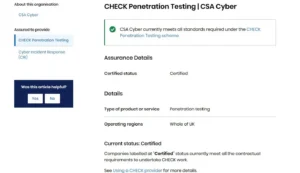
CSA Cyber appears in NCSC records for CHECK Penetration Testing and Cyber Incident Response.
These independently documented capabilities make it a relevant candidate for organisations seeking formal assurance.
Its CHECK entry identifies a London contact address in the South Bank area.
Where Might CSA Cyber Fit?
A business preparing to assess a sensitive IT environment may need technical penetration testing, while also wanting an incident response specialist available through a separate arrangement.
CSA Cyber’s NCSC records confirm relevant capability under both schemes.
However, buyers should understand the distinction between assurance of a provider and the scope of an individual contract.
The NCSC’s records establish that a provider meets the scheme requirements. They do not independently measure every commercial engagement or guarantee a particular customer outcome.
Our buying assessment: CSA Cyber belongs on the shortlist for buyers who require CHECK testing or an assured incident response supplier.
Question to ask: Which named specialists will undertake the work, and which current qualifications are required for our specific environment?
What Has Changed Since Older London Cyber Security Directories Were Published?
One of the problems with comparing cyber security companies using older directory articles is that familiar company names may no longer describe independent businesses.
Acquisitions and changes in corporate identity can affect which organisation signs the contract, operates the services and handles customer data.
Our research identified several examples that should be considered when updating older listings.
This does not mean that the services or expertise associated with older brands have disappeared.
It means that a directory written years ago may no longer explain accurately who supplies those services today.
For buyers, the safest approach is to confirm the current legal entity, official domain, contractual contact and service responsibilities.
Original Data Analysis: What Does the 2025/26 Cyber Security Survey Reveal?
The UK Government’s latest Cyber Security Breaches Survey offers important evidence about how organisations approach cyber protection.
Published on 30 April 2026, the survey used responses from 2,112 UK businesses, alongside charities and education institutions.
It found that 43% of UK businesses had identified a cyber security breach or attack during the previous year.
The figure was 65% for medium-sized businesses and 69% for large businesses.
These are national findings, not London-specific estimates.
Cyber Security Outsourcing by Business Size
We compared the government’s reported figures for 2024/25 and 2025/26.
Companies.london calculation: Changes are calculated by subtracting the previous survey’s published percentage from the latest figure.
Sources: UK Government Cyber Security Breaches Surveys 2025 and 2025/26.
The largest increase in this comparison occurred among micro businesses, while the reported proportion of large businesses using external providers fell.
The figures do not prove that individual businesses changed suppliers or moved security work in-house. The annual surveys use separate samples, and small movements should not automatically be treated as statistically significant.
Nevertheless, the pattern is worth examining.
Medium-sized businesses recorded the highest proportion of external provider use at 70%.
Large businesses recorded a substantially lower figure, despite generally operating more complex technology environments.
One possible explanation is that large enterprises are better able to maintain specialist security teams internally, while medium-sized organisations increasingly need external assistance.
That interpretation is consistent with the government’s discussion of outsourcing patterns, although the figures alone cannot prove the reason.
What Does This Mean for London Businesses?
A company with 150 employees may have substantial technology responsibilities without enough work to justify a large internal security operations team.
It might therefore benefit from a managed service alongside an internal IT manager.
A much larger business may already have dedicated analysts and require outside specialists only for penetration testing, assurance or unusually complex incident investigations.
This is why buying decisions should be based on the work that actually needs to be performed, rather than company size alone.
A Second Finding: Outsourcing Does Not Automatically Mean Testing
Another useful comparison comes from the types of cyber security activity reported in the government survey.
Our calculation shows that the proportion of businesses reporting external cyber security support is 35 percentage points higher than the proportion reporting penetration testing.
That does not mean every business needs penetration testing, nor does it prove that businesses outsourcing security are neglecting technical assessment.
The activities are different, and the survey does not establish which organisations fall into both groups.
The figures do, however, illustrate why businesses must be precise about what they are outsourcing.
A supplier responsible for monitoring suspicious activity might not be responsible for testing applications, assessing cloud configurations or reviewing the security of third-party vendors.
A complete security programme may require several complementary services.
What Should You Buy First: IT Support, Monitoring or Penetration Testing?
Before asking cyber security companies for quotations, identify the operational problem that needs solving.
Why IT Support and Cyber Security Should Not Be Confused
An IT support provider may manage employee devices, software installations and everyday technical problems.
A specialist security supplier may focus on identifying threats, investigating incidents and independently testing systems.
Some companies deliver both.
But a contract that includes antivirus software and routine patching should not be interpreted as comprehensive cyber security coverage.
For a wider comparison of day-to-day technology management, read our research on IT support companies in London.
Businesses interested specifically in endpoint and device protection can also examine our guide to computer security companies in London.
Cloud Security Requires Separate Questions
Cloud services introduce a different set of responsibilities.
A cloud infrastructure provider may manage the underlying hosting environment while the customer remains responsible for identity permissions, application configuration and other security controls.
The exact division varies according to the platform and agreement.
Organisations planning a cloud migration should compare the security implications alongside the technical and commercial benefits.
Our directory of cloud companies in London provides additional context for that part of the market.
A New 2026 Development: Cyber Essentials Requirements Have Changed
Businesses comparing security consultancy and certification support should be aware of the latest Cyber Essentials technical requirements.
Version 3.3 took effect on 27 April 2026.
The updated requirements clarify areas including cloud service scope, passwordless authentication and software development considerations.
In particular, the NCSC documentation states that cloud services cannot simply be excluded from scope.
This matters for businesses that have moved email, identity management, financial systems or other essential operations to external cloud platforms.
A company should not assume that outsourcing software hosting removes those services from its security responsibilities.
The appropriate certification scope must be determined using the applicable Cyber Essentials rules.
Businesses buying consultancy for certification should ask whether the proposal reflects the current requirements rather than an outdated checklist.
Why Security Testing Is Also Changing in 2026
The NCSC has also published updated documentation for its Cyber Adversary Simulation scheme.
Version 1.1 of the CyAS scheme standard was published in September 2026.
The scheme concerns advanced testing designed to assess an organisation’s ability to prevent, detect and respond to realistic simulated cyber attacks.
It is distinct from routine vulnerability scanning and should not be confused with ordinary penetration testing.
The NCSC has described the programme as being in an initial development stage, with further information for buyers to follow.
For organisations planning sophisticated adversary simulation exercises, the correct approach is to verify the current scheme status and provider requirements rather than assume that any existing testing accreditation automatically applies.
How Much Do Cyber Security Companies Charge in London?
Pricing is one of the least transparent areas of the cyber security services market.
Many providers offer bespoke quotations because the cost depends on the number of systems, security requirements, available staff and contractual response obligations.
A small application penetration test cannot sensibly be compared with continuous monitoring of an organisation’s endpoints, cloud infrastructure and identities.
Rather than publish unverified starting prices, we examined how different services are commonly purchased.
These are descriptions of common purchasing models, not claimed average market prices.
Our Original Cost Comparison Method
Two quotations should be compared over the same period and for equivalent services.
For a one-year agreement, a practical calculation is:
Comparable first-year cost = (monthly recurring charge × 12) + onboarding + required licences + excluded essential services + separately charged assessments.
For example, consider two hypothetical offers.
In this illustrative scenario, Supplier B is £1,400 cheaper on a comparable first-year basis, even though its monthly monitoring fee is higher.
These are invented example quotations used only to demonstrate the calculation, not prices obtained from the listed providers.
The illustration assumes that the included penetration test is genuinely equivalent in scope and quality to the separately purchased assessment.
If the services are not equivalent, the price comparison is not meaningful.
For a multi-year agreement, the buyer should also examine annual price increases, renewal arrangements and exit costs.
What Happens If a Cyber Attack Starts Outside Office Hours?
This is one of the most useful tests of a provider’s operational arrangements.
Imagine a London accountancy firm whose employee credentials are compromised at 11:45 pm.
An attacker signs into a cloud account, attempts to access client files and begins creating suspicious forwarding rules.
The monitoring service detects unusual activity.
The critical issues are what happens next.
A supplier may promise continuous monitoring but require approval from a customer representative before disabling access.
Another may have pre-authorised containment procedures.
A third may provide an investigation and recommend actions without making changes directly.
All three arrangements could be appropriate in different circumstances, but the customer must understand the difference.
The service agreement should identify who can disable accounts, isolate devices, preserve evidence and contact senior decision-makers.
There should also be an escalation procedure if the normal contact person cannot be reached.
Why a Published Response Time Needs Careful Interpretation
Claranet’s public MDR information offers a useful example.
Its published priority-one notification commitment is 15 minutes from classification.
This is a defined stage of incident management, not necessarily the elapsed time from the attacker’s first action.
A useful comparison therefore separates:
- Time from suspicious activity to detection.
- Time from alert creation to investigation.
- Time from classification to customer notification.
- Time from authorisation to containment.
When a provider publishes a single response figure, ask which of these stages it measures.
Three Buying Scenarios That Reveal Different Security Needs
The following scenarios are illustrative, not accounts of customers we interviewed.
A 35-Person Legal Practice
The practice stores confidential documents in Microsoft 365 and uses a specialist case-management application.
Its principal problems are identity security, protecting sensitive records and responding to suspicious activity.
The firm should assess its existing security controls before committing to an expensive enterprise monitoring contract.
If outsourced monitoring is required, the contract must cover the cloud identities and devices actually used by employees.
An Ecommerce Company Developing Its Own Checkout
A London retailer is replacing its checkout application and connecting it to a new stock management system.
Its immediate requirement may be a penetration test covering the application and relevant interfaces.
The retailer should also establish the payment security obligations applicable to its arrangements.
A supplier specialising in application testing could be more appropriate than an organisation selling a broad managed monitoring package.
For businesses planning new applications, our guide to software companies in London explains the wider development supplier market.
A Growing Business Using Several SaaS Providers
A consultancy uses separate cloud platforms for customer management, payroll, document sharing and project delivery.
Each platform has its own authentication methods, administrators and access settings.
Even where the applications are hosted by reputable software companies, the business still needs to manage its own identities, supplier access and contractual risks.
An assessment of cloud configuration and third-party access may provide better initial value than commissioning unrelated testing of individual devices.
Our comparison of software-as-a-service companies in London covers the wider SaaS market.
How We Recommend Comparing Three Cyber Security Quotations
A security buying decision should start with one specification issued to all shortlisted providers.
Otherwise, businesses risk comparing proposals that solve different problems.
We developed the following editorial scoring model to make the process more consistent.
Companies.london Supplier Evaluation Framework
This is an original procurement framework, not a recognised industry accreditation.
The weighting can be adjusted to match a company’s risks.
A business needing emergency incident response may place greater emphasis on immediate access to specialists. An organisation commissioning a highly regulated technical assessment may treat the appropriate assurance scheme as mandatory.
The scorecard should only be completed using evidence from quotations, contract terms, certification records and relevant work examples.
It should never be filled with guessed marks based on brand reputation.
Does a Provider Need a London Office?
Our review identified eight published London contact addresses across the selected companies, but a local office is not automatically a measure of technical quality.
Many security services can be delivered remotely.
Incident investigators may work from regional centres, monitoring teams may operate internationally and specialist testing can be carried out without a permanent presence at the customer’s premises.
On-site support becomes more important for engagements involving physical infrastructure, restricted environments or security requirements that prevent remote access.
Before selecting a provider based on its location, ask where the actual delivery team works and whether the engagement includes visits when required.
For businesses with data residency or overseas access restrictions, written contractual arrangements matter more than the postcode of a sales office.
What Legal Responsibilities Remain With the Business?
Outsourcing monitoring or incident response does not remove an organisation’s obligations under applicable data protection law.
Under the UK GDPR, certain personal data breaches must be notified to the Information Commissioner’s Office without undue delay and, where feasible, within 72 hours after the organisation becomes aware of them.
Not every cyber security incident is a reportable personal data breach.
An organisation must assess whether personal information was affected and whether the relevant reporting threshold is met.
A supplier that handles personal data on behalf of a customer may also have contractual and legal obligations to notify the customer promptly.
For that reason, security agreements should clearly address incident communication, evidence preservation and the information needed for regulatory assessment.
The Information Commissioner’s Office guidance explains how organisations should assess and report personal data breaches.
Final Assessment: Which Companies Should London Businesses Shortlist?
The central finding from our research is that cyber security providers should not be compared as though they all sell the same service.
NCC Group, LRQA, Claranet and CSA Cyber are relevant candidates for organisations requiring specialist technical testing and independently assured services.
Bridewell offers a combination of consultancy, assurance and managed security. ITC Secure, Integrity360 and Cybanetix have service portfolios relevant to outsourced security operations.
Kroll and S-RM are worth evaluating where digital forensics, incident investigation and broader cyber risk considerations are particularly important.
These are assessments of publicly documented service suitability, not a ranking of customer satisfaction or technical superiority.
A strong purchasing decision begins with a clear description of the systems to protect, the threats that matter most and the work the business cannot perform internally.
The provider should then be able to explain how it will meet those needs, what evidence it can supply and what happens when a security incident occurs.
The most useful cyber security contract is not necessarily the one with the greatest number of services. It is the one with responsibilities that are understood, measurable and appropriate to the business.
Frequently Asked Questions About Cyber Security Companies in London
Which Cyber Security Company Is Best for Small Businesses?
There is no single best provider for every small business. A company with limited technical resources may need help with Cyber Essentials controls, identity protection and backup recovery before purchasing a sophisticated monitoring service.
The appropriate choice depends on the systems and information at risk.
Which Companies Have NCSC CHECK Status?
Among our ten selected providers, we verified CHECK listings for NCC Group, Bridewell, LRQA, Claranet and CSA Cyber.
These records should be checked again before procurement because certification status and scheme requirements can change.
Are Penetration Testing and Managed Detection the Same?
No. Penetration testing investigates weaknesses in selected systems within an agreed scope. Managed detection and response provides ongoing monitoring and investigation of suspicious activity within the contracted environment.
An organisation may need both, but purchasing one does not automatically include the other.
Does Cyber Essentials Certification Mean a Company Is Fully Secure?
No. Cyber Essentials establishes a baseline of technical controls within a defined scope. It does not guarantee that every cyber risk has been eliminated.
Businesses may need additional controls, testing, monitoring and incident preparedness depending on their operations.
Do Cyber Security Companies Guarantee Protection Against Ransomware?
No reputable supplier can guarantee that every attack will be prevented.
Effective security combines preventive controls, monitoring, access management, backups, response planning and tested recovery procedures.
Should Businesses Choose the Cheapest Cyber Security Quote?
Not without comparing the work included.
A lower monthly fee may exclude response activities, additional log sources or necessary security assessments.
The better comparison is the cost of delivering the required protection and response arrangements over the full contract period.
Research Methodology and Disclosure
Research completed: 14 October 2026 Publisher: Companies.london
This article is based on independent desk research covering 10 cyber security providers serving London. We reviewed official company information, NCSC assurance records, UK Government statistics and regulatory guidance.
Our analysis includes original data comparisons and a practical supplier evaluation framework. No supplier interviews, hands-on testing or independent performance audits were conducted. Company details should be verified before making purchasing decisions.
Yes, you can remove the separate source links section, provided relevant authoritative sources remain linked within the article. Keeping those links supports transparency, credibility and reader trust.